


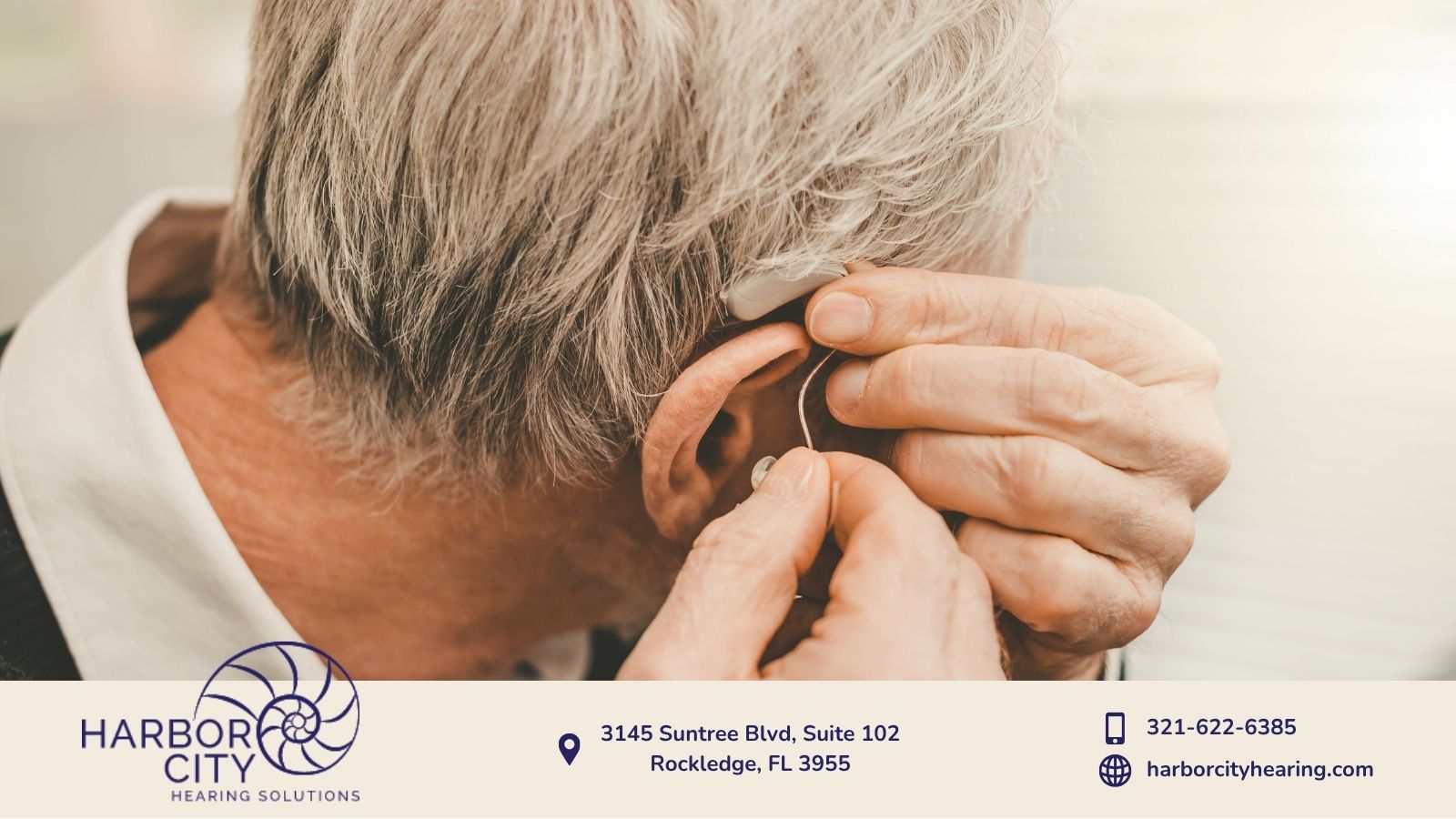
- Hearing aids should sit securely and comfortably, but the correct insertion method depends on the device style and earpiece.
- A simple routine can make daily insertion easier while helping prevent loose domes, feedback, soreness, and accidental damage.
- Harbor City Hearing Solutions provides hearing aid fitting and personalized follow-up care for patients in Rockledge, FL.
Putting in a hearing aid can feel awkward at first. The device is small, the parts may be difficult to see, and the right angle is not always obvious. With a little practice, most people develop a routine that takes only a few seconds.
The most important rule is to be gentle. Your hearing aid should feel secure, but it should not require force. Follow the instructions for your specific device because receiver-in-canal, behind-the-ear, and custom in-the-ear hearing aids are inserted differently.
Before You Put in Your Hearing Aids
Start over a clean, dry surface with good lighting. A mirror can help while you learn the motion.
- Wash and dry your hands so moisture, lotion, and debris do not transfer to the device.
- Check that the dome, earmold, or custom shell is clean and securely attached.
- Look for wax blocking the sound opening or wax guard.
- Confirm which device belongs in each ear. Blue usually indicates the left ear, and red usually indicates the right ear.
- If your devices are rechargeable, remove them from the charger. If they use disposable batteries, make sure the battery doors are closed.
Some hearing aids turn on automatically after they leave the charger or when the battery door closes. If feedback starts while you are inserting the device, cup your hand loosely over the hearing aid or ask your audiologist whether a short startup delay can be enabled.
How to Insert a Receiver-in-Canal Hearing Aid
Receiver-in-canal (RIC) and receiver-in-the-ear (RITE) devices are common. The main hearing aid sits behind the ear, while a thin wire leads to a dome or custom earpiece in the ear canal.
- Hold the hearing aid body and place it behind the top of your ear.
- Let the receiver wire rest over the ear without twisting it.
- Hold the receiver near the dome or custom earpiece, not by the middle of the wire.
- Guide the earpiece toward the ear canal opening.
- Gently push it inward with a small twisting motion until it feels comfortably seated.
- If the device has a retention tail, tuck it into the bowl of the outer ear.
The receiver wire should lie close to the side of your head. If the wire bows outward or the dome keeps backing out, the earpiece may not be fully seated, the wire length may be incorrect, or the dome may need a different size.
How to Put in a Behind-the-Ear Hearing Aid With an Earmold
A traditional behind-the-ear (BTE) hearing aid has a case behind the ear, a curved hook, tubing, and an earmold made for the shape of your ear.
- Hold the earmold with the canal portion pointing toward the ear canal.
- Place the canal tip into the opening of the ear.
- Gently pull the outer ear back and slightly upward with your other hand.
- Rotate the earmold backward as you press it into place.
- Tuck the upper portion of the earmold beneath the fold of the outer ear.
- Lift the hearing aid body over the ear and position it behind the ear.
Run a finger around the earmold after insertion. It should sit flush without a folded edge. A gap can cause whistling, and an earmold that is not fully seated may work loose as you talk or chew.
How to Insert an In-the-Ear Hearing Aid
In-the-ear (ITE), in-the-canal (ITC), and completely-in-canal (CIC) hearing aids place most or all of the device inside the ear. Their custom shape helps guide the correct orientation.
- Hold the hearing aid between your thumb and index finger.
- Keep the faceplate or controls facing outward. If the device has a removal cord, it should remain accessible.
- Place the canal tip at the opening of the ear.
- Gently pull the outer ear back with your other hand.
- Press and slightly rotate the hearing aid until it sits comfortably in its intended position.
Do not use the battery door, microphone opening, or removal cord to push the device into place. If the shell stops before it is seated, remove it and try again from the starting angle rather than forcing it farther into the ear.
How Should a Hearing Aid Feel When It Is Inserted Correctly?
A correctly inserted hearing aid should feel secure but not tight. After the first few minutes, you may notice the device less. New users can be aware of mild fullness while they adjust, but sharp pain, persistent pressure, or a sore spot is not normal.
Check the fit by looking in a mirror and moving your jaw as if you were talking or chewing. The hearing aid should remain in place. Speech should sound clear according to your programmed settings, and the device should not produce constant feedback.
Contact your audiologist if you notice:
- Pain, tenderness, or broken skin
- A dome or earmold that repeatedly slips out
- A receiver wire that pulls tightly or sticks far away from the head
- Feedback that continues after the device is fully seated
- A sudden weak, muffled, or distorted sound
- A dome that is loose, torn, or missing
If a dome appears to be missing after you remove the hearing aid, do not place tools in your ear. Contact a hearing care or medical provider for guidance.
Common Problems When Putting in Hearing Aids
The Earpiece Will Not Go In
Check that you have the correct device for that ear and that the earpiece is facing the canal. Pulling the outer ear gently back can help straighten the canal. Stop if insertion hurts. Earwax, swelling, an incorrect dome size, or a change in the ear can make insertion difficult.
The Hearing Aid Keeps Popping Out
Make sure the earpiece is fully seated and the retention tail is tucked into the outer ear when one is present. Movement while talking or chewing can reveal a dome, wire, or earmold that needs adjustment. Your audiologist can change the earpiece size or remake an earmold when necessary.
The Hearing Aid Whistles
Feedback can occur when amplified sound leaks out and returns to the microphone. Push the earpiece gently into its normal position and check for a loose fit. Earwax, a blocked filter, cracked tubing, or a programming issue may also cause whistling.
One Side Feels Different From the Other
Ears are not perfectly identical. One hearing aid may require a slightly different angle, and the earpieces may not be the same size. However, one side should not consistently hurt or feel unstable. Ask your audiologist to inspect the fit rather than trying to reshape or trim a component yourself.
How to Remove Hearing Aids Safely
For RIC and BTE devices, lift the hearing aid body off the ear first. Then grasp the dome, receiver, or earmold near the ear and gently twist it outward. Do not pull on the thin wire or tubing.
For custom in-the-ear devices, use the removal cord if the model has one. Otherwise, grip the outer edge of the hearing aid and ease it out with a gentle twisting motion. Opening and closing your jaw may help loosen the seal.
After removal, wipe the device with a clean, dry cloth and place it in its charger or storage case. Follow the cleaning and wax-filter instructions provided for your model.
Practice Makes Insertion Easier
Use the same order each day: identify the correct side, place the hearing aid, check the earpiece, and confirm comfort. Practicing while seated over a towel can protect the device if it slips from your hand.
If arthritis, reduced sensation, vision changes, or dexterity problems make insertion difficult, tell your audiologist. A different device style, larger controls, a custom earmold, or a simple handling tool may make daily use easier.
Get Help With Hearing Aid Fitting in Rockledge, FL
Learning how to put in hearing aids is part of a complete hearing aid fitting. Harbor City Hearing Solutions can check the physical fit, confirm that the right and left devices are being worn correctly, and make adjustments when a hearing aid hurts, whistles, or will not stay in place.
If you are still struggling after several days of practice, schedule a follow-up visit instead of forcing the device or giving up on it. A small change to the dome, earmold, receiver length, or programming can make hearing aids more comfortable and easier to use.